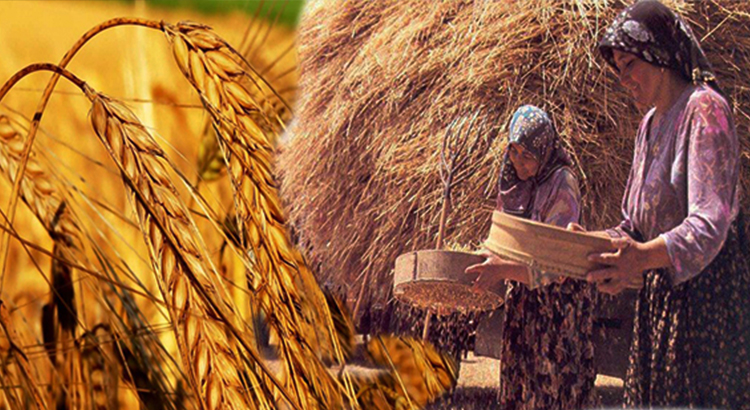
Jineoloji is a river finding its own way. The ideas of every woman, her study, the data she finds, the secrets her mother whispers in her ear, the power of interpretation, these are all drops that strengthen the flow of this river. Its most beautiful aspect is its spontateous enlightenment of social blindness. Jineoloji is ensuring that knowledge conveyed to it is carried to society. Furthermore, jineoloji is embellishing research in all fields, whether economy, health or history.
The struggle of Kurdish women became visible with the attacks by ISIS on Kobane in 2014. We say ‘became visible’ because the Kurdish women’s struggle has a history of nearly 40 years (if we accept the founding congress of the PKK in 1978, attended by Sakine Cansız, who was murdered on 9 January 2013, as a starting date). That is, the confederal organization of women in all four parts of Kurdistan is solely a result of the struggle against ISIS. So the result of what? As Kurdish women being part of a party waging an armed, ideological struggle for national identity against dominant nation states, or the result of an increasingly original response from within the vanguard party to the women’s question? I believe that both are fundamental factors, knowing that we are not bound to social science that reduces realities to a single element.
There is a system under the umbrella of the Kurdish women’s party (PAJK) that is waging a struggle for national identity, with numerous self-defence organisations, in Rojava the YPJ (YPG), in Rojhılat [East] HPJ (Women’s Protection Forces), in Bakur [North] YPS Jin (HPS – Women), in Şengal [Sinjar] YJŞ (Şengal Women’s Union), the main source of these being YJA STAR, with a confederal system carried out by TJA- Tevgera Jinen Azad in Bakur, RJAK in the South, KJAR in the East, Kongreya Star in Rojava, TJK-E in Europe with loose links to the KJK (Komen Jinen Kurdistan , Kurdistan Women’s Communities). If we add hundreds of assemblies, communes, NGOs, faith groups, women’s sections of political parties and initiatives I think I will not be able to come to our main subject.
The above mentioned organisational, institutional and systematic progress is a significant step forward in women’s struggle for existence. However, there is still a long way to go. Of course we have approached the subject in the words of Kurdish people’s leader Öcalan: ‘the first oppressed class, the first colony and nation are women’. We thus say that the crucial point regarding women’s struggle for existence is a transformation in mindset. This is precisely the reason we discuss the question of jineoloji – science of women, something we are often asked. It is our belief that only a strong construction of mindset at this systematic level of development will ensure social transformation. Most important of all is the fact that although every advance we make organisationally, politically, practically and theoretically makes a contribution to social transformation, it can only resolve a part of the social problems of women, which are a Gordian knot. The patriarchy of the government, which has constructed itself on the basis of women’s bodies, feelings, ideas, beliefs and labour, intervenes constantly in our daily lives. It invades our space with violence, exploitation denial, murder and creating illusions. As important as tearing off these masks and organising a strong self-defence against these patriarchal attacks is the construction of a mindset. Jineoloji, which we have reached by setting out from a paradigm based on freedom, will succeed in achieving this. Jineoloji argues it can supersede the patriarchal system, not only physically, but also with a self-defence mindset. We are aware this is a large assertion. The basis of our assertion is constituted by a desire to correct the distortion of consciousness created by capitalism which mutilates concepts. In that case, we may begin by redefining women and science.
What is a woman? Women are the first form created by the universe, which wanted variety. A form that combined all other elements with its own reality, giving an original universal meaning, combining beauty, variety and a free flow.
Öcalan evaluates the subject of women as a social mass, a reality with economic, social and political dimensions beyond the subject-object and gender, pointing out that women constitute the broadest section of social nature, both physically and as regards meaning. He says women should be defined as the essence of society, not the dregs.
What is science? Science is the method of cause-effect, connections, power of change and developed thought of human beings within the living universe. In other words, it is a product of the social mind that transforms itself into a force for change. We women challenge with social intellect the 5 thousand-year-old state civilisation, claiming we will bring about change. For this reason we say jineoloji. That is, we want to bring women, who have been distanced far away from science, closer to it and for social reason to operate.
What is science’s connection to social affairs?
Jineoloji will construct itself as a social science, for it has many objections to social sciences and will develop on these objections. At this juncture let us list our objections: firstly, the fact that social sciences, which consider they implement natural laws in society, carry out social engineering. The cycle of the universe is uniting, not splintering. We are opposed to social sciences dealing with society as an object, for when society is perceived as an object the social scientist sees themselves directly as a subject. Solutions presented without taking emotional, intellectual, geographical or social conditions into consideration will cause unforeseen consequences. Merely looking at how many predictions regarding the Arab Spring came true and the results of initiatives that were not in harmony with the social fabric of the Middle East will suffice, I believe. We object to social science constituting rigid, universal, unchanging laws for society. Let us assume you are a sociologist. Can you claim that the reasons for violence against women and the solutions are the same in America as in Guinea? Or can you produce the same solutions for a woman who has suffered FGM in Yemen and a woman in Britain who is suffering psychological trauma? Most important of all, can you claim to be able to touch the souls of these women from afar, saying ‘science is impartial’? Doesn’t the fact you are distant from society mean you have closed the gap with the rulers? Can you be a social scientist by seeking the origin of problems in the East, but seeking the solutions in the West? Doesn’t separating social science into areas of expertise conflict with universal laws?
Is it merely a coincidence that social sciences, divided up into hundreds of sections and different disciplines, has not made women, the vanguard of socialisation, the subject of research? Instead of defining women as the fundamental element and initiator of socialisation, it has defined it as the weakest link and the source of problems.
Jean Jaccques Rousseau defined women as ‘a potential disorder needing to be tamed’. Auguste Comte, the founder of sociology, claimed women’s brains were smaller than the ideal racial type. The subject of research was only the white European man.
In fact this is not only a distortion of social science, but also a great distortion of the previous structures of knowledge, mythology, religion and philosophy. Plato, after saying women would do the same work as men, added that ‘women would be given easier jobs on account of the weakness of their sex’.
Aristotle said that ‘slaves have no ability to think, women do but it doesn’t function.’ Doesn’t mythology also play a role in the distortion of the reality of women by claiming a woman was the source of all evil (Pandora’s Box)?
Don’t religions, too, portray women as the cause of all disasters, making this mentality created by patriarchy into a divine command? To give a few examples,
Thomas Aquinas’s personification of women was as follows: ‘God knew women would commit sin beforehand. Women came into being as the result of a great mistake or through the use of the wrong materials.’
In the Old Testament of the Jews are the words: ‘I created women out of a part of Adam’s body that is always covered and hidden so that she would always remain covered and chaste.’
The 223rd verse of the Quran says: ‘Women are your fields. You may treat them as you wish…’
It is clear that social science and previous knowledge structures made absolutely no renewal of mentality when it came to women, for the existence of women was always defined in relation to men. These issues are the aspects accepted as part of the current crisis of social sciences The difference of Jineoloji starts from here, wishing to put a stop to the distortion inflicted on the existence of women.
Perhaps Öcalan’ words, ‘the thing men tell most lies about is women’ is sufficient to understand this question. Let us now define jineoloji.
Jineoloji as a concept
Jineoloji is a Kurdish definition. I particularly stress this, for the place of women in Middle Eastern societies (natural society) is a leading one, contrary to the current circumstances.
Although the mentality of the patriarchal system has tried to eradicate the existence of women, an etymological study will illustrate this point. When we look at Indo-European language groups we see that many words connected to the word life are feminine. The word life (jiyan) in Kurdish is derived from the word for woman (jin), just as the word for life in Persian (zendegi) comes from the word for woman (zen). The word for freedom in Sumerian, margi, means return to mother. In the Sorani dialect of Kurdish afrat means woman, while afirandın means to create. Other words deriving from the word jin include jindar (liveliness) and jinda (life-giving). The word for tree (wê darê) in Kurdish is feminine, whereas a piece of wood (wî darî), that is no longer alive, is masculine. As we can see, even in the language life energy is female while the developed form with frozen energy is male.
If we broaden the definition of jineoloji a little: it is the science that studies women based on the identity of life-woman, nature-woman, social-nature-woman, the culture thus created, its reflection on historic society and the reasons, sources and outcomes of the transformation of institutions, structures and concepts stemming from the definition of women. We may also define jineoloji as life science, social science, meaning science democratic modernity science and free co-life science in addition to science of women.
Abdullah Öcalan made the first evaluation regarding the conceptualisation of jineoloji 7 years ago in the book Sociology of Freedom.
‘It is an indisputable fact that women make up the broadest section of social nature, both physically and as regards meaning. In that case why shouldn’t such an important part of social nature be a subject for science? There is no other explanation for the failure of sociology, which has been divided up as far as Pedagogy for children, to constitute a science of women other than the dominant male discourse. ( p. 289)
Is it correct to define jineoloji as a branch of social sciences or of the sociology of freedom? This is an ongoing debate that we are having. However, let us make a proposal without placing it within existing perceptions. If the main aim of jineoloji is to define the existence of women, then as long as it is successful in this it will be able to be a force of resolution for social problems and will develop a freedom option. In this context it would be more correct to call it not a branch of the sociology of freedom, but, more accurately, the science of activating it. The sociology of freedom aims essentially to combine social science with society’s freedom orientation. As for jineoloji it is the activation of the philosophy and scientific analyses of the sociology of freedom based on the reality of women and life. That is, there is a close connection between the two based on complementing, not on inclusion.
Why did we define jineolojias the science of democratic modernity? When Öcalan said civilisation was a five-thousand-year creation of men he defined democratic modernity as a civilisation of women. The aim of jineoloji is to bring into the open the existence of women. As the science of women constructs itself, progress will be made in women’s freedom. Both mentally and practically correcting distortions pertaining to women will bring into the open a level of freedom. Consequently, women, the fundamental element of democratic modernity, will become a lot more active and the flow of democratic modernity will strengthen further. This is the reason for defining the 21st century as the epoch of women’s freedom. As every science has to respond to the needs of the age, defining jineoloji as the science of democratic modernity will be an appropriate concept. As we constantly say, ‘this world should be woven with the spirit of women’….
Our reply to those who consider jineoloji to be an ideological and organisational move is clear. We already have an ideology. Since 1998 we have the ’Women’s Liberation Ideology’ the principles of which are patriotism, free thought, free will, organisation and struggle. We also have dozens of organisations based on various social needs and identities. Consequently, this is not what we want to do with jineoloji, which is women’s intellect, knowledge and methods of women’s socialisation. It will be an important sphere in the construction of a mentality of democratic modernity. If a link has to be made with an ideology, then it will be useful to take a look at Öcalan’s determination of an evolution towards a consistent social science between ideological, sociological and scientific socialist thinking. It is the strongest critique of the positivism of ‘As the measure of science in the ideological and sociological capacity of revolutionary parties develops it indicates that it has won the freedom it promised society’.
Jineoloji is a struggle for the mentality of social sciences
Jineoloji’s critique of social sciences may also be understood as a mentality intervention in this sphere. By correctly defining women with regards to all spheres of life the effects of positivism and the patriarchal system on social sciences may be overcome. In the light of Öcalan’s critique that ‘existing structures of knowledge have either dissolved in existing authorities or become stunted sects’ the structure of knowledge established by authorities will be subjected to criticism and also research their own epistemology and methods. It is evident that authority has kept women away from spheres of knowledge. So are we women really deprived of knowledge? Or can we gain knowledge from our experiences?
Although authority endeavours to do this we cannot claim we are without knowledge. It is therefore necessary to include the knowledge we gain from our experience in the epistemology of jineoloji. From the leavening of dough to the treatment of sick people, from the ploughing of the land to the domestication of livestock women have obtained most of theiur knowledge from life experiences. Aren’t the moments we call instinct or superstition the product of knowledge passed on from generation to generation and stored deep in our minds? At the jineoloji workshops organised in Sur after it was devastated during the self-government resistance, this knowledge is emerging and is being rendered of value.
In Kurdistan all women rise before the sun and pray. When asked why they do this, be they Yazidi, Alevi or Sunni, most women do not know why they do this, saying they have learned like this. Women also say ‘Ya Star’ as an entreaty. As ‘Star’ is the mother goddess in Sumerian culture, similar to Astarte, Isis, Venus and Cybele in other cultures, doesn’t this indicate a continuing link to the culture of the mother goddess?
In short, jineoloji, before gathering scientific data on Kurdish women and submitting papers to academic circles for their approval (I am not belittling them), will first seek knowledge obtained by Kurdish women through life experiences, the most unblemished and unpretentious of knowledge. This first light that enlightens history is made all the more precious by the fact that most people would not even consider it as knowledge.
The dialectic of the Kurdish women’s movement has worked like this…. Analysis of Women and Family (1986), women’s own organisation (YJWK), women’s army (late 1992), YAJK, which was established in guerrilla areas and put the freedom of women on the agenda of the Kurdish freedom movement, women’s party (PJKK-PJA and PAJK) and the situation reached today with the KJK system. Apart from these institutional structures there are the theories developed in order to render the women’s question visible.. Women’s liberation ideology, killing the man, endless divorce, social contract, free co-life etc… These come into being in the cycle of theory and practice that nourish each other and the theories and institutions that are the source of the epistemology of jineoloji.
Of course, this is not enough by itself. While constructing our epistemology we will also confront the ruling structures that ruin the structure of knowledge and look sceptically at the basic arguments of capitalist modernity, sexism, nationalism and religious dogma that influence our thought processes.
The relationship of jineoloji and feminism
Will we have no support? First and foremost feminist epistemology that criticises social sciences and unmasks patriarchy is a key source.
While examining this the fact we will not leave the field of practice will be an advantage as regards seeing the congested sides of feminism. Let us add here that jineoloji is not an alternative to feminism. On the contrary a symbiotic tie with feminism may create a new liveliness. The fact that feminism has been unable to establish a strong bond between individual freedom and social freedom, in Öcalan’s words ‘its imprisonment in the academies that are the traps of capitalist modernity’, its failure to comprehend the strong link between freedom and organisation and develop an alternative life style are the first aspects that come to mind. The correction of these ‘may lead to a successful revolt of the oldest colony’.
However, feminist epistemology will not be our only source of support. While establishing the epistemology of jineoloji benefit may be gleaned from the results of academic research. Importance will be attached to academic study, but the fundamental criteria will be the use of the knowledge obtained for the benefit of women and society. The experiences of a woman troubadour, a woman healer, the diary of a woman guerrilla, the biography of a woman resister and research in the area may all be utilised equally.
Jineoloji will constantly monitor the ethical dimension of knowledge. The problem is not one of attaining knowledge, rather it is having the capacity to utilise the knowledge attained to enhance social and individual life.
While jineoloji develops its philosophy of knowledge it will attach importance to the dynamism, variety and flexibility of life and the constant change involved. It will prioritise observation, experience, listening and inclusiveness and produce new meanings.
Pertaining to the methodology of jineoloji
What social science claims is scientific is nothing other than melting down the existence of women and men in the crucible of authority. For this reason it is important to have a research method based on the reality of women. Since the principal sphere of examination for social science is the social arena which develops around women our research methods will concentrate on revealing the existence of women and on exposing the distortions regarding women. Jineoloji will develop a critique of how all social sciences, (history, sociology, archaeology, theology etc) have concealed and distorted the existence of women. More detailed research will also be carried out, for instance into self-defence of women. In order to do this contact may be made with social science. When examining this topic relations will be forged with social sciences such as economy, ontology, education, health and politics. (The fifth issue of Jineoloji magazine features an article on women’s self-defence and covers all the subjects mentioned). Such research will help overcome the divisions in social sciences.
Jineoloji does not have to confine itself to a single method, for to do this would condemn it to a ‘dictatorship of mentality’. Therefore the guidelines will be how much does this method develop the enlightenment of women, does it add meaning?
A monist universal approach reduces truth to a single one, whereas sometimes one individual’s break for freedom can even change truth. For instance, Arin Mirkan’s action was a turning point in the breaking of the DAESH encirclement. To claim an unlimited relative model is as true as the number of human beings in the universe may splinter social integrity. Both the universal ‘one’ and the relative ‘sole one’ reflect a hegemonic character.
The method of jineoloji lies in the dual character of the universe. That is, it considers universitality and relativity concentricly.
It is able to appreciate the progressive aspect of the cycle of development and the cyclical character of progress, and the mutual influence of endlessness and the moment and evaluate the significant threshold of perception to understand truth.
Jineoloji bases its methods on a mentality that surpasses the separation between subject and object. It avoids making this divide absolute, which is the basis of modernity.
Jineoloji resolves to function in harmony with emotional and analytical intellect and carries out its observations and experiences taking into consideration the quantum dualism.
It takes into consideration the relationship between observer and observed and a person’s inner view. Constant observation of yourself cannot help you understand the feelings of society. Let us say that you are a journalist in Kurdistan and that your only aim is to report objectively the events that take place during the self-government resistance. In that case, in order to explain what the mother of Cemile Çağırga, a girl whose corpse was stored in a freezer for days, went through, or the children of Taybet İnan, whose body was left for days on the street on account of a curfew, first you have to make them feel that you understand them.
One of the fields to which jineoloji pays particular attention is that of freedom. To sum up, it takes into account the quantum idea, social nature, flexibility and the potential for change.
It examines and assesses the ways of thinking about mythology, religion, philosophy and science and the positive and negative dimensions of the methods they use.
Jineoloji does not see the state, classes and social development as inevitable stages of development and rejects the determinist, positive viewpoint of history.
Jineoloji does not see its main areas of research being universities , official academies and institutions. It approaches these places with suspicion on account of their potential for generating power. The relationship between teacher and student is not one of subject and object, but progresses in a symbiotic relationship. Dialogue, research, self-expression, personality analysis (a kind of psychoanalysis), criticism and self-criticism are the main methods of academic education. Educational establishments are important for the ethical dimension of science and for protecting the link with society. Apart from official institutions, every house, association or mountainside may be utilised as an educational space.
As jineoloji establishes its method, it will criticise the methods of elements of democratic modernity that are closed to experience.
In conclusion, jineoloji will establish its methods, taking into account the flow, colour, versatility, flexibility and varied facets of life.
Pertaining to the theoretical and institutional framework of jineoloji
Since the concept of jineoloji first emerged there is curiosity as to what it has accomplished. The jineoloji committee formed in 2011 endeavoured to find an answer to the question as to what need had led to the emergence of the science of women first asked in Öcalan’s Sociology of Freedom. The answer came at the First Jineoloji Conference held in the mountains of Kurdistan in 2015 in the form of the ‘Introduction to Jineoloji’, (original in Turkish, translations in Kurmanji, Sorani and Persian completed, English, Spanish and German in progress). While seeking answers to this question we reached the conclusion that the science of women should be constructed around the link between social science and society. It was built on research into the existence of women and on the methods it would determine and with which social science it would form links. As it progresses on this path it may be engaged in a profound study to conceptualise the science of women. As it tries to explain the concept to society it reveals the truth of the words ‘if science is the answer to social needs it will fulfil this duty’. Jineoloji is finding a response in society.
One of the most important activities in the constituting of the theory of jineology was the quarterly theoretical journal Jineoloji, the first issue of which was published on 8 March. The magazine, the fifth issue of which is being compiled, endeavours to weave a connection between jineology and life in each issue. The first issue focused on the crisis of social sciences, the second on the problem of method, the third on the women’s revolution and the fourth on self-defence. The Jineoloji magazine is read from Rojava to Turkey and the mountains of Kurdistan, and from Latin America to Europe.
Our research and every meeting we hold to explain jineoloji is an expression of our progress (Europe, Rojava, North, South, Turkey and as far as Latin America). It cannot be said that the question of why a science of women has found the same reply everywhere. Jineoloji work in Europe is still at an early stage, whereas in Rojava work on a conceptual framework has achieved results. Presently work is continuing on the formation of a theoretical and institutional framework. The first teachers trained at the Jineoloji Academy to give classes on jineoloji, which is on the curriculum in all academies, graduated last October. Academic study will not be limited to this. Next spring there will be new courses at the Jineoloji academy, which are expected to be attended by researchers and academics who are engaged in work on the existence of women in social sciences. In another development, brochures and books have been prepared by the Jineoloji committee (The Politisisation of Emotions, The Co-Presidential System and Volume 3 of Öcalan’s analyses of the Women’s question). Work is also continuing on the unwritten history of Yazidi women in Sinjar. Debate is continuing as to whether jineoloji should have a faculty or be a section of the Rojava University, which opens this year. The jineoloji committee is of the opinion that there should be a jineoloji faculty, for which serious preparations must be made. At the present time jineoloji classes are part of the education programme at hundreds of academies (YPG, YPJ, assemblies, self-defence, economy and numerous others). It is also on the curriculum of middle schools and high schools. This is also the case at Maxmur camp.
Jineoloji is a river finding its own way. The ideaes of every woman, her study, the data she finds, the secrets her mother whispers in her ear, the power of interpretation, these are all drops that strengthen the flow of this river. Its most beautiful aspect is its spontateous enlightenment of social blindness. Jineoloji is ensuring that knowledge conveyed to it is carried to society. Furthermore, jineoloji is embellishing research in all fields, whether economy, health or history.
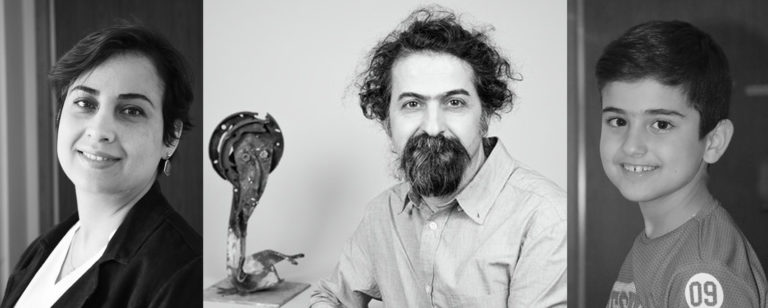
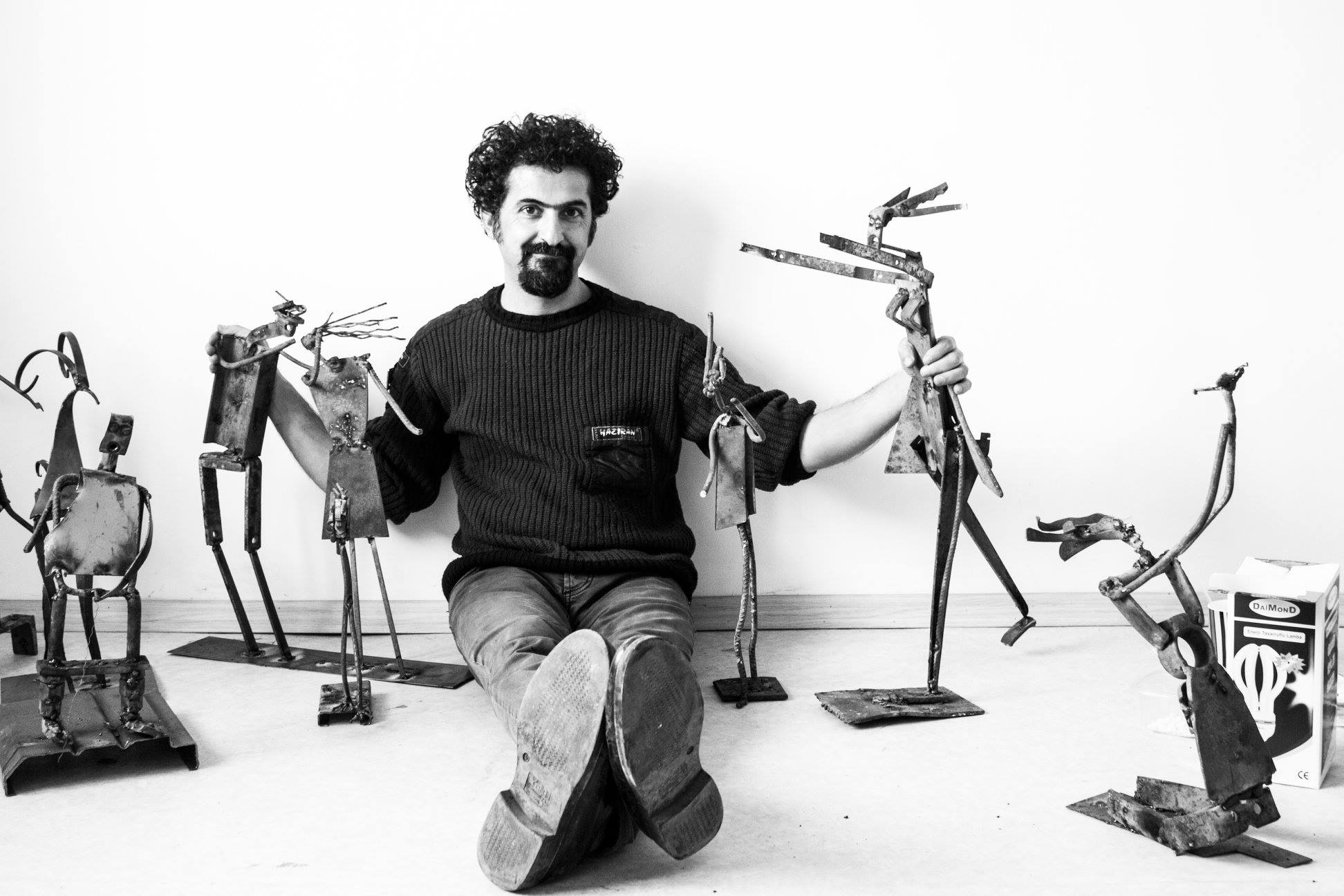 Seywan Saedian est sculpteur, peintre, photographe, designer, cinéaste, poète. Il est spécialisé dans la réalisation de sculptures en métal par la ferraille.
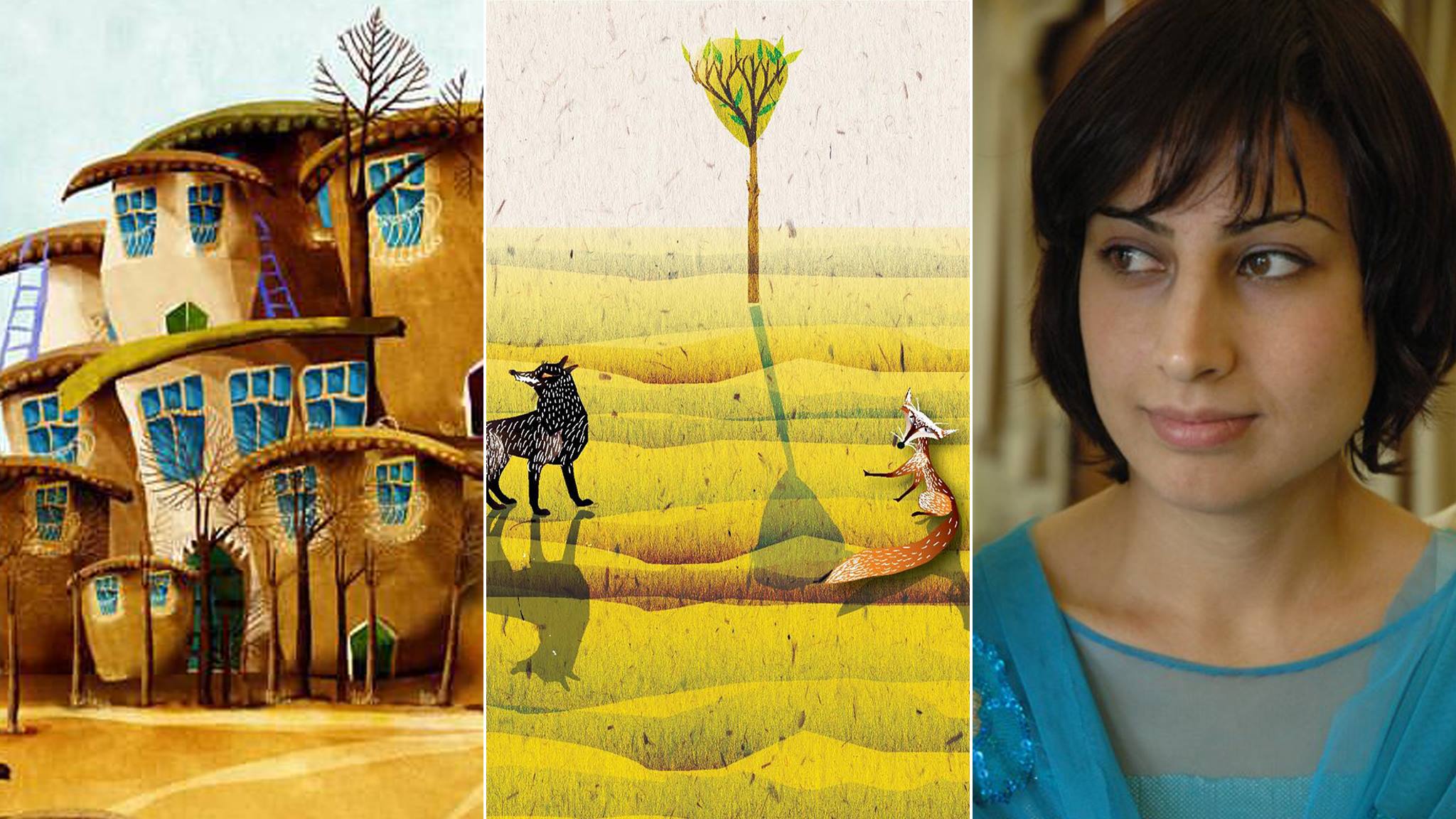 Runak Rasoulpour est graphiste, illustratrice, artiste travaillant également la céramique.