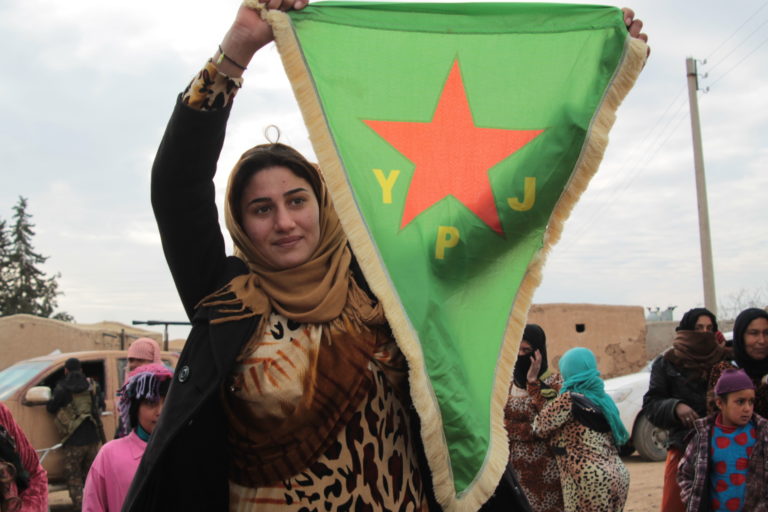
Le bureau d’information des combattantes internationalistes des YPJ a publié une lettre ouverte à toutes les femmes qui sont de gauche les appelant à renforcer la lutte féministe. (English below)
« Lettre ouverte à nos sœurs gauchistes du monde
Depuis des milliers d’années, les femmes sont victimes de l’oppression et de la domination de la figure masculine, dans toutes les sociétés et cultures différentes. Notre société s’est développée selon les règles du système capitaliste en utilisant le patriarcat et le sexisme comme principaux outils. Nous pouvons en voir le résultat aujourd’hui : Les attaques contre le corps des femmes sont légitimées par les lois, les États, les institutions, et avec l’aide du système capitaliste, une guerre contre les femmes a été créée. Cela ne peut être ignoré. Au fil du temps, la société nous a traités de sorcières, d’hystériques, de folles, de faibles… La société veut que nous soyons soumises et silencieuses. Nous avons été enfermées, tuées, humiliées et punies pour la simple raison que nous sommes nées femmes. Est-il si surprenant qu’aujourd’hui, partout dans le monde, des femmes se soulèvent ? La libération des femmes est notre priorité. Nous ne pouvons imaginer un monde libéré de l’oppression sans nous débarrasser de la première forme d’oppression et de violence. Des sœurs d’Argentine, du Chiapas, du Soudan, d’Europe, d’Inde, d’Afghanistan, d’Irak et du nord de la Syrie participent à cette lutte. Nous sommes toutes liées par le même objectif : la révolution des femmes.
Pour y parvenir dans le monde entier, nous aimerions vous montrer l’approche du Mouvement des femmes kurdes, qui s’est développé dans un contexte avec des défis uniques, à commencer par un système féodal. Au sein de la formation militaire des YPJ et des YPG, nos méthodes sont claires. Les structures de pouvoir sont découpées et utilisées comme base des opérations. Cette approche comprend une unité composée uniquement de femmes. Nous pouvons voir comment les femmes entretiennent des relations entre elles et comment les hommes entretiennent des relations révolutionnaires et libératrices avec les femmes. Un exemple parfait est le suivant : les hommes ne peuvent pas prendre de décisions concernant les femmes, mais les femmes peuvent participer aux processus de prise de décisions concernant les hommes. Les hommes en sont venus à comprendre et à faire confiance aux femmes de manière significative – ils savent que les femmes ne quitteront jamais la lutte, qu’elles sont ce qui garantit le succès de la révolution. Les mots des femmes ont le même poids que ceux des hommes dans les assemblées, et nous portons les mêmes uniformes. Un autre exemple est le suivant : les femmes ne critiqueront pas ou ne seront pas en désaccord avec d’autres femmes devant des camarades masculins d’une manière qui [peut la rabaisser] par les hommes ou qui montre des vulnérabilités exploitables aux hommes, mais elles se soutiendront mutuellement jusqu’à ce qu’elles soient dans un espace entièrement féminin où nous pourrons discuter des différends et en donner la perspective. Dans la vie militaire, il n’y a pas de fréquentations ou de relations sexuelles. Cela change les interactions entre camarades parce que cela change les désirs, les besoins et les attentes des hommes à l’égard des femmes, et vice versa. Les femmes sont capables de travailler avec les hommes, mais elles sont autonomes par rapport à eux. De cette façon, en tant que femmes, nous apprenons à nous respecter et à nous aimer nous-mêmes et à aimer les autres femmes. Cette unité est à son tour la base pour laquelle les hommes, le reste de l’armée, la société et le monde nous regarderont. Ces nouvelles relations de genre se sont développées indépendamment. Notre construction de la féminité n’est pas en référence aux hommes.
Historiquement, la guerre a toujours été la prérogative des hommes, mais cette révolution ne l’est pas. Le monopole de la stratégie militaire n’est pas laissé à un processus décisionnel exclusivement masculin. Bien au contraire : comme nous l’avons vu dans l’opération de Raqqa, qui était dirigée par une femme. La perspective des femmes ajoute beaucoup à la compréhension de la lutte armée – il est clair pour nous que la victoire militaire et la libération des terres ne marquent pas la fin de la lutte – le vrai travail est plus profond que cela et se poursuit maintenant.
Une révolution n’est pas une résolution claire et simple, c’est un effort incessant qui ne cesse d’avancer ensemble et qui se poursuit encore aujourd’hui. Un vrai changement vient de la compréhension de nos erreurs et des contradictions en nous-mêmes. Nous ne sommes pas à l’abri des influences du patriarcat, alors quand nous luttons pour le déconstruire, nous devons analyser nos comportements, et chercher les ombres du patriarcat en nous aussi, afin de ne pas tomber dans ses pièges.
Cette approche différente de la libération que nous apprenons ici aboutit à une sorte de liberté que nous n’avons jamais connue auparavant. Dans les sociétés occidentales, le concept de liberté est présenté comme quelque chose de très individuel. Les libertés individuelles sont élevées au-dessus de tout, et la liberté collective ne fait guère partie de la conversation. Les femmes sont encouragées par la société, en cherchant le respect des hommes, à se séparer des autres femmes : à chercher à être plus intelligentes (…) plus ambitieuses et à dépasser les autres femmes. Cette compétition divise notre force et nous apporte très peu. Ici, nous cherchons la libération pour les femmes collectivement. Nous comprenons que notre liberté est inextricablement liée à celle des autres femmes, et que nous ne pouvons vraiment avancer dans notre lutte pour la liberté qu’ensemble. En vivant ensemble et en apprenant à nous aimer vraiment, révolutionnairement, nous sommes capables de devenir plus libres qu’aucune d’entre nous ne pourrait l’être seule.
Nous ne rejetons pas les hommes et nous les comptons certainement parmi nos camarades. Nous avons une organisation distincte qui fonctionne de façon autonome. En collaboration avec les YPG, nous poursuivons sur cette voie pour continuer à bâtir le monde que nous savons possible. Abdullah Ocalan, leader idéologique du mouvement kurde, a déclaré : « Libérer la vie est impossible sans une révolution radicale des femmes. » Les femmes kurdes ont certainement créé un front contre le patriarcat dans le monde entier que des personnes de diverses origines ethniques, culturelles, économiques, politiques et nationales ont reconnu comme tel et l’ont rejoint en sachant que nos luttes sont toutes liées et ne peuvent être séparées par des frontières, ce qui a donné naissance à un bel élément nouveau : Camaraderie [Hevaltî en kurde]. Cela se produit lorsque les femmes vivent et luttent collectivement pour atteindre le même objectif révolutionnaire dont il a été question plus haut : Libération de toutes les femmes.
Heval peut se traduire par « camarade », mais pour nous c’est beaucoup plus. La camaraderie entre les femmes est à la fois une tactique de lutte contre la domination et le fruit de la révolution des femmes. En partageant intimement nos vies à tous les niveaux, comme nous le faisons aux YPJ, nous détruisons l’isolement et l’individualisme créés et imposés par le capitalisme. La vie collective radicale fait de chacune de nous un miroir, nous nous voyons dans les yeux de l’autre et nous sommes forcées de confronter nos défauts, d’utiliser nos forces et d’apprendre à communiquer honnêtement les unes avec les autres. En nous connaissant nous-mêmes et en nous connaissant les unes les autres, nous construisons chacune ensemble une personnalité plus révolutionnaire.
Hevaltî est une redéfinition du mot amour. […] L’amour n’est pas ce qui se vend dans un magasin pour la Saint-Valentin. L’amour n’est pas un document légal donné par l’État, et ce n’est pas un pacte conclu dans une église. Ce ne sont pas les femmes qui se donnent aux hommes. L’amour, c’est les femmes qui luttent ensemble. L’amour, c’est la légitime défense, et se défendre l’une l’autre. L’amour, c’est construire un monde nouveau où chaque femme peut être en sécurité et libre. L’amour est discipline et dur labeur. L’amour nouveau est révolutionnaire. C’est la camaraderie et il se répand déjà à travers le monde, unissant chaque femme et l’assurant : Tu ne marcheras plus jamais seule. »
Bureau d’information des combattantes internationalistes des YPJ
YPJ International Fighters Info Office
– An open letter to our leftist sisters of the World –
For thousands of years woman have been the subjects of oppression and domination by the male figure, in all different societies and cultures. Our society has been developed following the rules of the capitalist system using patriarchy and sexism as principle tools. We can see the result of this in the present day: Attacks on woman’s bodies are legitimized by laws, states, institutions, and with the help of the capitalist system, a war on women has been created. This cannot be ignored. Through the years, society has called us witches, hysterics, lunatics, weak… Society wants us to be submissive and silent. We have been locked up, killed, humiliated, and punished for the simple reason that we were born women. Is it so surprising that today, women all over the world are rising up? Women’s liberation is our priority. We cannot imagine a world free of oppression without getting rid of the first form of oppression and violence. Sisters from Argentina, Chiapas, Sudan, Europe, India, Afghanistan, Iraq and here in Northern Syria all share in this struggle. We are all connected by the same aim: a woman’s revolution.
In order to achieve this worldwide we would like to show you the approach of the Kurdish Women’s Movement, which was developed in a context with unique challenges, starting in a feudal system. Within the Military formation of the YPJ and YPG, our methods are clear. Power structures are carved out and used as a basis of operations. This approach includes a unit which is comprised of only women. We can see how women relate to each other, and how men relate to women in a revolutionary and liberatory way. A perfect example is: men cannot make decisions about women, but women can participate in decision making processes about men. Men have come to understand and trust women significantly—they know that women will never leave the struggle, that they are what guarantees the success of the revolution. Women’s words have the same weight as men’s in assemblies, and we wear the same uniforms. Another example is: women will not criticize or disagree with other woman in front of male comrades in a way that opens her up to being diminished by men or shows exploitable vulnerabilities to men, but instead will support each other until they are in an all female space where we can open up about the disagreements and discuss them, giving perspectives. Within military life there is no dating or sexual relations. This changes interactions between comrades because it changes the wants, needs and expectations that are put on women by men, and visa versa. Women are able to work with but are successfully autonomous from men. In these ways, we as women learn to respect and love ourselves and other women. This unity is in turn the basis for which men, the rest of the military, society, and the world will regard us. These new gender relations have been developed independently, Our construction of womanhood is not in reference to men.
Historically, war has been the prerogative of men, but this revolution is not. The monopoly of military strategy is not left to an all-male decision making process. Quite the opposite: as we have seen in the Raqqa operation, which was lead by a woman. The perspective of women adds much to the understanding of the armed struggle—it is clear to us that military victory and the liberation of land does not mark the end of the struggle—the real work is deeper than this and continues now.
A revolution is not a clear cut and simple resolution, it is an unceasing push forward together, one that continues even now. A real change comes from understanding our mistakes and the contradictions within ourselves. We are not immune to the influences of patriarchy, so when we struggle to deconstruct it, we should analyze our behaviors, and look for the shadows of patriarachy within ourselves as well, so as not to fall into its traps.
This different approach to liberation that we are learning here results in a kind of freedom we have never known before. In Western societies, the concept of freedom is presented as something highly individual. Individual freedoms are elevated above all else, and collective freedom is hardly part of the conversation. Women are encouraged by society, in seeking the respect of men, to separate ourselves from other women: to seek to be smarter, more assertive, more ambitious and to surpass other women. This competition divides our strength and wins us very little. Here, we seek liberation for women collectively. We understand that our freedom is inextricably tied to that of other women, and that we can only truly advance in our struggle for freedom together. By living together and learning to love each other truly, revolutionarily, we are able to become more free than any of us could be alone.
We do not reject men and surely count them among our comrades. We have a separate organization that operates autonomously. Working together with YPG, we push forward on this path to continue building the world we know is possible. Abdullah Ocalan, ideological leader of the Kurdish movement, said: “Liberating life is impossible without a radical woman’s revolution.” The Kurdish women have surely created a front against patriarchy worldwide which people from many ethnic, cultural, economic, political and national backgrounds have recognized as such and have joined with the knowledge that our struggles are all connected and cannot be pulled apart by borders.A beautiful new element emerges as a result of this: Hevalty. This is created when women live and struggle collectively towards the same revolutionary goal discussed above: Liberation of all women. Heval may translate as “comrade,” but to us it is much more. Hevalty among women is both a tactic to combat domination, and is itself the fruit of the women’s revolution. By intimately sharing our lives on every level, as we do in the YPJ, we destroy the isolation and individualism created and forced upon us by capitalism. Radical collective living turns each of us into a mirror, we see ourselves in the eyes of the other and are forced to confront our flaws, to utilize our strengths, and to learn to communicate honestly with each other. By knowing ourselves and each other, together we each build a more revolutionary personality.
comradry is a redefinition of the word love. We are reclaiming love from a capitalist and patriarchal world. Love is not what is sold in a store for Valentine ́s Day. Love is not a legal document given by the state, and it is not a pact made in a church. It is not women giving themselves to men. Love is women struggling together. Love is self defense, and defending each other. Love is building a new world where every woman can be safe and free. Love is discipline and hard work. It is revolutionary. This is comradry, the new love, and it is already spreading across the globe; uniting every woman and assuring them: you will never walk alone again.
YPJ International
27 may 2019 YPJ International Fighters Info Office