« The slave, who cannot say anything to his master, may end up believing that he is guilty of the crime for which he has taken responsibility. »
It is with this sentence that the Kurdish historian, Sedat Ulugana begins his article on the role of the Kurds in the Armenian genocide. An article that Ulugana wrote after having scoured the Russian, British and French archives relating to the Armenian genocide and after having carried out research in the regions of Northern Kurdistan (Bakur). A salutary clarification to put an end to these attempts to further overwhelm the Kurdish people who have already been on the ground for a century and to whom many take malicious pleasure in pushing even deeper the knife planted in their hearts. A stateless people who are held responsible a little too easily for all the evils of the earth.
Some circles claim to have « sufficient information and evidence showing that a considerable part of the Kurds participated in the [Armenian] genocide ». In fact, I am curious about the « information and evidence » that we do not have.
“Genocide » refers to physical destruction as well as mental loss. The Armenian genocide of 1915 strongly contains both of these characteristics. However, despite the annihilation of the Armenians, the term « genocide » is relatively new. The events that took place in the context of the Armenians were defined as « terrorism » in the mid 1800s, a « massacre » towards the end of the century and after the Holocaust process [targeting Jews], a political project aimed at « genocide », that is, ending « race » itself. Undoubtedly, thousands of texts have been written about historical truth. However, it can be said that most of them fail to come close to the substance of the truth. Because first of all, the oral collective memory is bypassed, and then attempts are made to corner or acquit one of the parties. What is even more interesting is to try to blame the Kurds for this genocide or certain Kurds who take responsibility for this crime on behalf of the masters. Here I will try to focus on the phenomenon in the article from Fırat Aydınkaya entitled « The Armenian Genocide and the Kurds in Eight Questions ».
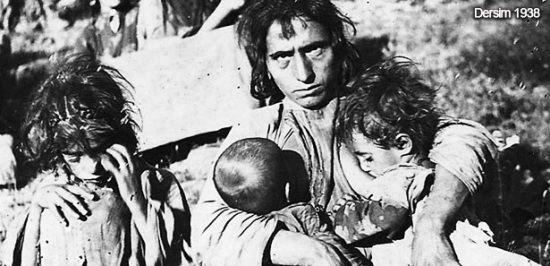
Whenever there is talk of the Armenian genocide, Turkish historical circles and institutions immediately put forward the argument that the documents should be opened. However, since « genocide » is planned and implemented as a project based on intent, genocide is based on the destruction of everything (including the dead human body) as far as possible. Traces of this approach can be seen in the Nazi camps of Dersim, Zilan, Rwanda and Bosnia. But the data that genocide has failed to destroy is the « speech » that envelops the collective memory. Whether or not there is material evidence, the gigantic collective memory in Anatolia and Kurdistan tells us that genocides are taking place in these lands.
Personally, I do not believe that the Ottoman Empire did not have a secret agenda targeting Armenians, and I do not agree with the thesis of some circles that « the massacre took place spontaneously during the war years ». Genocide conceptually contains a uniform agenda and a disciplined framework. However, when we look at the massacres against the Armenians, the « deficiencies of the plan » stand out. The main reason for this is that the will of the local often prevails over the will of the center. This is not only specific to the massacres of the Armenians, but is an ancient characteristic of the undisciplined Ottoman administration. It is precisely from here, from the point where the will of the local is visible, that the attempt to blame the Kurds for genocide begins.
Some circles claim to have « sufficient information and evidence that a considerable part of the Kurds participated in the [Armenian] genocide ». In fact, I am curious to know what « information and evidence » we do not have. Again, I don’t understand how and on what basis they determined the phrase « a considerable part that should not be underestimated ». On the other hand, the thesis that « there are many places where tensions between Armenians and Kurds were murderous » is also extremely problematic. If the places they imply are the provinces of Bitlis and Van, it is useful to delve into the issue in the historical and social context.
Contrary to the claims of some scholars, Sunni Kurds constitute the majority of the total population of the two provinces. While the ancient geography of Bitlis province is home to many Kurdish seigniories (led by Mirs) (Bitlis, Hîzan, Şîrvan, Xerzan / Garzan, Hezo, Çapakçur, Karni, Zirki) of Marwani, if we exclude the fortress of Van and the surrounding towns, we will see several Kurdish principalities (Hekari, Westan, Miks, Bargirî, Mehmûdî and partially Bazîd). While the Armenians constitute the « reaya », i.e. the « fileh » (fellah/farmer), as the Kurds say, the Kurds are deployed as « tribes » and are mainly used as operational powers in the « economy of plunder » of the Kurdish feudal lords (the Mirs). Pillage does not imply an internal action in this process, which means that, contrary to the claims of some Ottoman historians who distort it, here we are talking about an external action towards the enemy of the Mîr, not a pillage committed by a tribe of the seigniory aiming at the pillage of the Armenian peasant of the same seigniory.
This historical and widespread relationship between Kurds and Armenians lasted until the 1850s. After the liquidation of the Kurdish Mirs, the structure of the tribes in the Kurdish geography changed. In this process, a « re-tribalization » took place, the « red fez master » sent from Istanbul was not effective, and it was the « sheikh » caliphs of Mevlana Halit who tried to bridge the political and social gap. While these sheikhs were at work, they « suffered » from the weak religious codes of the Kurdish-Armenian community, which were particularly closely linked. If we take into account that a considerable part of the Kurdish tribes in the 1860s were êzdis (yazidîs), we see how difficult the work of the sheikhs was. In this process, the sheikhs began to work by resurrecting especially the Kurdish tribes and led this process through anti-Christianity. The anecdote of Halidî Norşin Şeyh Diyaddin (Sheikh Hazret) who blocks his nose saying « they smell bad » when he crosses the plain of Muş populated by Armenians, and who pulls his hand from his nose saying « it smells like a rose of paradise » once he arrives in the area of the Badikan tribe.
In summary, sunnization continued uninterrupted until the early 1900s, including the period of the Hamidiye regiments, and this process was a project aimed at the Kurds before the Armenians. In fact, Safi Pasha, who visited the region, could not hide his astonishment when he saw that the majority of the Armenians in Garzan did not speak Armenian, and that the Kurds were Muslim only in name but lived more like Armenians.
With the exception of a few elite Kurdish families from the Hamidiye regiments in the early 1900s, there was a spirit of solidarity and living together between Kurds and Armenians rather than hostility. Of course, we should not ignore the looting expeditions and mass murders of the Hamidiye regiments during this period. The Hamidiye regiments, who were nostalgic for the lordships of the Mirs as an Ottoman project, not only undertook plundering expeditions against Armenians, they also attacked tribes who could not find a place in the Hamidiye system and plundered their areas. They didn’t content themselves with that, they fought and plundered each other. In this context, the Hesenan-Heyderan and Sîpkan conflicts should immediately come to mind.
The violence of the Hamidians has also created a solid basis for Armenian revival. When the Taşnaksutyun (Armenian Revolutionary Federation – Hay Heghapokhakan Dashnaktsoutioun) emerged as a political formation, it succeeded in uniting Armenians against all Kurds thanks to the accumulated hatred against the Hamidian Kurdish clans. (The Hamidiés were light cavalry regiments of the Ottoman army created in 1891 and recruited mainly from the Kurdish tribes. Their name « Hamidiye » comes from that of Sultan Abdülhamid II).
Given the gaps in the Ottoman archives of the period, I can make a humble suggestion: refer to and examine the notes and observation reports that Russian, British and French diplomats wrote to Van and Bitlis.
During this period, the organisation Taşnaksütyun pursued an extremely contradictory policy. One wing of the movement proposed to support a peaceful programme towards the Kurds and proposed to contribute « to the process of forming contemporary Kurdish identity as well as to modernising Kurdish society itself ». A second wing argued that the Great Armenian Empire could be rebuilt together with the Byzantine Empire. And that according to this nostalgia, the « savage Kurds of the mountains » should be expelled from the « ancestral homeland ».
The constitutional monarchy of 1908, i.e. the revolutionary regime of the « young Turks », was a major breaking point in Kurdish-Armenian relations, as well as in the whole Ottoman sphere.
Prior to this date, the Hamidian Kurds, who were loyal servants of the Caliphate and the Ottoman Empire, were designated after 1908 as « criminal collaborators of Abdulhamid’s cruel regime » as well as « unconstitutional and anti-progressive reactionaries ». Armenians were considered to be harmful to the state until 1908, when they were gradually recognised as « victims of the Hamid regime ». And without a doubt, the architect of this transformation was the organization Taşnaksütyun [Dashnaksutyun: The Armenian Revolutionary Federation or ARF, abbreviated to Dashnak/Dashnak or Tashnag/Tachnag].
Thus, Rupen Pasha, one of the leaders of the Dashnaksutyun organization, who was fighting the regular Ottoman troops in the plain of Muş, went down to Muş a few days later after learning about the declaration of the new 1908 constitution. Accompanied by the applause of the people of Muş, the latter joined Ömer Naci and his military parade through the city. It should be noted that Ömer Naci would later become one of the senior officials of the Special Organization (Teşkilat-i Mahsusa) involved in the Armenian genocide. And he hugged the Hodja Ilyas Sami, who was described as the « provincial organizer » of the genocide.
Similarly, Hodja İlyas Sami, who never claimed his Kurdish identity, and Keğam Garabetyan, were jointly and continuously elected to the Chamber of Deputies as deputies for the district of Muş, within the alliance of the Committee for Union and Progress [CUP, in Turkish İttihat ve Terakki Cemiyeti]) and the organization Dashnaksutyun (1908-1914).
In the process in question, the « scapegoats » are now the Kurds, in particular the Hamidiye regiments. With the declaration of the constitutional monarchy, an attempt was made to eliminate the Kurdish elite. Kör (blind) Hüseyin Pasha fled to Iran, his brothers Fetullah and Seyyid Ali (who were poisoned in the prison of Muş in 1909) were arrested, and the offices of the Kurdish Society « İttihat ve Terakki Cemiyeti (İTC) » were closed down one by one.
During this period, Father Vartan, Regent of Muş, wrote in a letter of denunciation he sent to the central office of the Committee of Union and Progress (İTC) that « the Kurds who are meeting will rise up against the Constitutional Directorate and will kill the Armenians in the process ». In the letter of denunciation by priest Vartan, the lords of Heyderan, Cibran, Hesenan were meeting with the Sheikhs of the dervish brotherhoods of the Gayda, Norşin and Küfra, who were disputing a network of followers and issuing fatwas against each other and accusing each other of being in deception. Later, following investigations by the secret agents of the İTC, one would understand that such a meeting had never taken place!
Aydınkaya claimed that the Kurdish intelligentsia, which was born at the time of the Dashnaksutyun-İTC electoral alliance, had used the term « internal enemy » for Armenians, referring to an article by Salih Bedirhan, a member of the former Bedirhan dynasty, published in the magazine « Rojî Kurd » in 1912. These sentences, taken from Salih Bedirhan’s overall discourse and used as « evidence » to condemn the Kurdish intelligentsia for the genocide, ignore the fact of an impulsive resort to racist articles targeting Kurds published every day in dozens of Armenian newspapers and weeklies across dozens of cities around the world, including Istanbul, Paris and London.
Those who try to condemn the Bedirhanis for the « genocide » may not know that the articles by Abdurahman Bedirhan, who belongs to the same family and intellectual category, published in the newspapers « Pro-Armenia » and « Kurdistan » and praising the Armenian struggle, were found on an Armenian federation captured in Geliyê Guzan! The same people probably don’t know either that Salih Bedirhan sent a letter entitled « Never persecute Armenians » to Timur, Emin and Hüseyin Pachas in Ercis!
The Russian journalist Mr. Berezowsky, who was said to be an intelligence officer according to the claims of the French priest Bonte, met Yusuf Kamil Bedirhan in Siirt in the spring of 1913 (Yusuf Kamil later confirmed this meeting). Berezowsky assured him that Russia intended to « give independence » to the Kurds and that they would receive weapons. In exchange for this guarantee, he asked Bedirhan to kill the Armenians first. Bedirhan strongly disagreed with the « massacre » request and immediately informed the French and exposed this veiled plan of the Russians towards the Armenians.
A year later, as the fruit of the Kurdish movement had matured, a Kurdish rebellion broke out in Bitlis, and despite Caliph Selim’s friendly letters to the Armenians calling on them to collaborate or at least remain neutral, the Armenians gathered around the Dashnaktsutiun movement armed themselves in order to suppress the « Bitlis rebellion » and fought the Kurds by allying themselves with İTC.
In the words of the French vice-consul, « The Kurds, who saw the lifeless bodies of Sheikh Shahabeddin and Seyyid Ali on the gallows, will hold not only the İTC but also its ally Dashnaktsutioun. » Of course, the alliance İTC-Taşnaksütyun was not content with that alone, it was going to kill Hertoşili Şekir, one of the most important cadres of the Kurdish movement at the time and who inspired the song « Şekir Ağa », which is still sung today in the Van region. Maybe the reason why Xelîl Xeyalî, from Bitlis, who « considered Armenians as enemies, and called them ‘kurmê darê’ (the worms of the tree), comes from this event!
Aydınkaya maintains that during the years of the genocide, officers of Kurdish origin were in the ranks of the Ottoman army, claiming that these intellectuals were involved in the action phase of the genocide. However, in the ranks of the Ottoman army at that time, in addition to Kurdish officers, there were also officers of Armenian origin, such as Torosian, dozens of Arabs, Turks, Albanians, Bosnians and Circassians who were also on the war fronts. Cibranlı Halit Bey, accused of having joined and even led the genocide for many years, was on the Palestinian front, far from the areas where Kurds and Armenians live. He arrived in the area at the end of 1916 and saved hundreds of Armenian civilians from the hands of Deli Halit Pasha around Kars, taking them to the Aras tribes. We know that Kadri Cemil Pasha and Ihsan Nuri also saved hundreds of Armenian civilians around Iğdır and Kars. We know that Hesen Hişyar Serdî resisted the gendarmes at the cost of his life to save children.
Aydınkaya wanted to give an example of Kurdish literature, quoting the verses of Hecî Qadirê Koyî: « Xakî Cizîr û Botan, ye’ni willatî Kurdan / Sed heyf û mixabin deyken be Ermenistan » (« Unfortunately, they call « Armenia » the lands of Botan and Cizre, i.e. the Land of the Kurds ») and describing his lines as an inspiration for the genocide! How could this Koyi verse inspire the massacres that will take place some 25 years later? Koyi, who was in Istanbul at the time, had been giving an example of the nationalist discourse that spread across the Ottoman continent. Here, it is possible to speak of the reading of the ‘North-Western Armenian Kurdistan’ debate within Kurdish nationalism rather than of its anachronistic content as an inspiration for the Armenian genocide.
It should also be remembered that the poet, with his harsh temperament, who does not refrain from describing Kurds who do not speak Kurdish as « bastards », never saw the north of the area called « Wilayeti Kurdan » and the « Armenian-Kurdish » geography, in the words of the Orientalists.
I would like to add a few more characters, in addition to actors such as Feyzi Bey, Hoca İlyas Sami and Hacı Musa Bey, and who participated in the massacres that began in April 1915 and lasted throughout the year. Gıdıkzade Süleyman in İdris, Vanlı Şevket Efendi in Van, and Seidê Nado in Muş – we know that almost all of these characters were members of Teşkilat-ı Mahsusa until the fall of 1914. Pirinçizade Feyzi Bey single-handedly seized the vast majority of the city’s Armenian property after the deportation of Armenians to the Diyarbakır region, which allowed his nephew, Ziya Gökalp, to join the Istanbul community as a Turkish ideologue. The same Pirinçizade was the architect of the defeat of the Kurdish movement during the Sheikh Said rebellion in 1925 and of the Kurdish massacres in the Palu-Genç-Lice triangle.
Hodja İlyas Sami, nicknamed Topalzade (the inhabitants of Muş said of him: « If Topalzade was a bridge, it would not be possible to cross it »), was a former Kemalist cadre who handed over the leader of the Azadî movement, Cibranlı Halit Bey, to the State and seized the plains of Muş from the Kurds after the Armenians.
Gıdıkzade İdris and Süleyman (Hüsamettin Cindoruk’s in-laws) confiscated all Armenian property in the city centre of Erciş. During the rebellion of Ağrı they personally participated in the murder of 15,000 Kurds in the Zilan stream. Vanlı Şevket Efendi (grandfather of the « journalist » Fatih Altaylı), even after taking over the Armenian churches in Van, took part in the Zilan massacre in 1930 and added the Kurdish villages of Zilan to his lordship. Seîdê Nado, meanwhile, was killed in a clash in Bulanik in the winter of 1916 « before he could get any spoils ».
One of the important names of Teşkîlât-ı Mahsûsa [Special Organization created by the leaders of Ittihad in 1914 and implicated in the Armenian genocide], Hacı Musa Bey (grandfather of the leader of the Islamic Front of the Grand Orient – İslami Büyük Doğu Akıncıları Cephesi [IBDA-C], Salih Mirzabeyoğlu) was an agent who infiltrated the Azadî movement. This is explained in detail in the reports deSakıp Bey, then governor of Muş. Hacı Musa Bey complained in Ankara because he was not willing to share Armenian land with Hodja İlyas Sami. He was exiled first to Sinop and then to Kayseri. In his letter (sent from exile) to Mustafa Kemal [Ataturk], he wrote: « Remember my services from the Armenian atrocities and the Sheikh Sait period, Your Excellency. I have heard that you have established a farm in Ankara [Ataturk Orman Çiftliği, SU], take me with you, I am ready to be your shepherd. »
Unable to find grace in the eyes of Mustafa Kemal, he took refuge with Kör Hüseyin Pasha who was elegantly in exile. He escaped from there to Binxet, the Rojava of today. He joined the Xoybun Movement [Khoyboun], half of whom were former cadres of Dashnaksutyun and defended the Kurdish-Armenian alliance. But he passed away a few months later. His son Medeni killed Kör Hussein Pasha and returned to Turkey, to be included in the « militia » by the government which amnestied him. For years, Medeni has been hunting in the midst of Muş the « sword remnants » [those who survived the Kurdish massacres of the time] of the Seyîdxan, Elîcan and Ağrı rebellions. As for Kör Hüseyin Pasha; he was sent to the surroundings of Sarıkamış-Erzurum in the autumn of 1914. He fought at the front until 1916. When he was defeated, he took his family with him and fled to Urfa and was not able to return to the region until 1920. Personally, I suggested in several articles that he might have been involved in the massacres in Kör Hüseyin Pasha, but after finding Mela Muhemedê Zîlanî’s war diary, I realized that he had never visited his own area between 1914-1920. After his return to the region after 1920, Hüseyin Pasha was exiled to Istanbul in 1926. All his property was confiscated and he was not allowed to return. All his children, who escaped from the places of exile to join the rebellion of Ağrı, were killed, except for Mehmet and Nadir Suphandag.
I would also like to talk about Maruf Ağa from Bekiran, which is part of my personal story. Maruf Ağa is my father’s grandfather. He did not hand over any Armenians from the village of Cergeşîn from Ercis to the district governor of Erciş at that time. After handing over the Armenians to the Russian troops approaching the area, he returned to his village, but three days later the same Russian troops attacked his village. Maruf Ağa pleaded and took up arms with 18 relatives. Maruf Ağa and 18 relatives, who were caught in the « machine gun » fire, died within a few hours. An Armenian federation recognized the body of Maruf Aga. He turned to his friends and said: « Isn’t it +Krivê Mero+ (godfather Maruf) who is protecting our offspring from the district governor of Erciş?” He asked for Maruf’s silver snuffbox, pipe and amber rosary Ağa and took them back to my great-grandmother, Meyro.
As pointed out earlier, the genocidaire cannot destroy the « speech ». From what the word tells us, the Armenian nation and its habitat were destroyed in the process. However, unlike those who accuse the Kurds of genocide, we have no written or verbal evidence of the Kurds’ involvement in the genocide with joint concerted participation. According to current Kurdish oral history, there is almost no evidence that tribal regiments were involved in the 1915 massacres, although there is talk of the participation of Kurdish individuals and small groups.
We know that some of these tribes had limited involvement, particularly in mountainous areas, because these operational Kurdish horsemen, deported to the front, were struggling to hold out against the advance of the Russian army as early as the winter of 1914. We also know that in 1915, i.e. at the time of the massacres, almost the entire male population aged between 15 and 60 in most Kurdish villages and tribal localities was enlisted and sent to different fronts.
In fact, in the spring of 1916 it was impossible to see a group of tribesmen in Bitlis and Van. According to Nogales, in many towns, for example in Bitlis, Adilcevaz and Muş, massacres were carried out by gendarmes on the orders of district governors and governors. The fact that some of these gendarmes are Kurds or that the majority of the members of Teşkilat-ı Mahsusa in the region are Kurds does not mean « public participation ». I am thinking of the village guards who were taken to Afrin and fought against the Kurds. Should we quote those guards and say, « The Kurds seized Afrin and gave it back to the jihadist terrorists » ?!
As for the question of « Armenian property », the cultivated land in the region at that time corresponded to 10% of the total area. In other words, agricultural activities were extremely limited and there was no cultivation and land ownership on almost all the current land. In the title deeds initiated after 1925, we see that the Kemalist cadres seized large areas of land and, in 1947, 19 million acres of land were given to them. At this point, it does not occur to anyone to wonder who the gigantic landowners such as Ünal, Sazak and Menderes seized the land from! Moreover, Ismet Pasha’s precise order was: « Do not let the Kurds settle in the villages emptied of Armenians, Turkish immigrants will be placed there.”
A large part of this property was distributed among former unionist notables who became the new Kemalist city-dwellers, and this capital was transformed into a source of income, particularly in the context of the implementation of the Turkification policy in Kurdistan and the introduction and settlement of the population brought in from outside.
Some writers say in this connection that the massacre of Kurds by Armenian partisans is a spontaneous and isolated act. However, we know that during the Russian invasion, Armenian fighters took their places in the Russian army and entire [Kurdish] tribes were massacred. Ereb Şemo, a renowned Kurdish Bolshevik novelist, is a direct witness of these massacres. At Muş, countless Sunni and Alevi civilians were massacred. Even men were raped. Especially in Van, the Muslim population was massacred by Aram Pasha, who went on to be the first Minister of the Interior of the future Republic of Armenia.
Thousands of Kurds fled its areas and took refuge in the mountains of Hakkari and most of them died of cold and hunger. More than a million fled and settled in Konya [central Anatolia] and Çukurova [the full length of Adana province, in southern Turkey]. Half of this population died from hunger and contagious diseases. In fact, Deveciyan wrote in the telegram he sent from Kilikya to Nubar Pasha, who was in Paris, « Kurds should no longer be allowed to return to these areas.”!
Aydınkaya states that the Kurdish intelligentsia of the time was conducting political activities in the « disarmed areas » in accordance with Wilson’s principles (the writer still loses sight of the fact that these areas have been emptied of their Kurdish populations). He goes even further, stating in particular that the newspaper Jîn tries « to lighten the burden of genocide », and writes: « the genocide is minimized and unimportant. » Apart from a few missing issues, Jîn was published in the Latin alphabet and anyone who wishes to read the newspaper from beginning to end can do so. What are the statements that downplay and make unimportant the genocide that we have not seen and that Aydinkaya has noticed?
During the Sèvres peace conference, « Jîn » carried out active propaganda, indeed it was a militant media. It was the semi-official broadcasting organ of the « Kürdistan Teali Cemiyetié » (Organization for the Development of Kurdistan). Its financier was the Kurdish delegate, Muhammed Şerif Pasha, who worked with Nubar Pasha in Paris.
In the diplomatic archives of France, one can find a map showing the territories of the future Armenia to be established and the territories of an autonomous Kurdistan in accordance with Wilson’s principles. The red line belongs to Nubar Pasha and the blue to Şerif Paşa (Pasha). It jumps out on this map that the red and blue lines are fighting almost like roosters trying to define common borders. During this period, the Kurdish-Alevi tribes of Erzincan and Koçgiri sent letters to Şerif Paşa stating: « The northern borders of Kurdistan are delimited by the northern part of the Erzincan massif and the Sivas region. We will not accept any other borders ». At the same time, a delegation of Armenians in Kilikya, in the zone of French occupation, sent a memorandum to Nubar Pasha « to deal with the case of a few thousand Muslims ». In this memorandum, with a definition of « Kurdology » reminiscent of that used by present-day Armenia, it was stipulated that « the clans », « the nomads » « the Kızılbaş », « the Yazidis » and « the Zazas » could not be considered Kurdish. Only a few « Kurdish » clans could, according to them, be classified as such. And so it was to be insistently stipulated at the Sèvres peace conference that in the regions of « Van, Erzurum and Bitlis » the Kurds were in a minority in relation to the Armenians.
The distinction of two societies so intertwined cannot be reduced to nationalism or religiosity emerging within the two communities. However, to deal with the issue only within the framework of Armenian theses or to endorse the « master’s » crime as much as the imaginary fight of a red and a blue line on a map is bitterly ironic. The slave, who can do nothing against the « master », gradually begins to convince himself of the latter’s responsibility for his crimes. To try again to shift the responsibility for this crime, which Orhan Miroğlu, now in adoration with the « conquerors of Afrin », had endorsed at the time when he was trying to get closer to the left and the Turkish liberals, on the basis of some baseless concepts of the Kurdish oral and written literature, is a mistake and is in contradiction with science, history and the reality of the facts.
I stressed the importance of words at the beginning of this article, and at the end of this article I take refuge again in the importance of words. My personal story is identical to that of the overwhelming majority of Kurds. My childhood took place in an Armenian village by the Van Sea, where the [Turkish] state installed my family after the Zilan massacre (massacre of the Kurdish population of the valley of Zılan in 1930 by the Turkish government). I grew up among the « Haçkar » and my great-grandmother Nûrê used to tell us, every time she baked bread in the bakery, the tragic story of the women and children that the government militia of « Siyahmed Çavuş » threw into an oven. We, Kurds of Serhat, all have a grandfather, a grandmother who has her grave near Revan (Yerevan). The bard and poet Reso, said in his poem written at the age of 8 (1911):
« The crane flies from Yerevan to the villages of the Igdir Valley…
and brings the land of Yerevan clinging to its wings.
At the border there was no trace of ink, neither blue nor red.”
The French version of article is here and the Turkish-one there